For a long time, we’ve been taught to treat nature as something separate from us – a resource to extract from, manage, and ‘care for’ when it’s convenient.
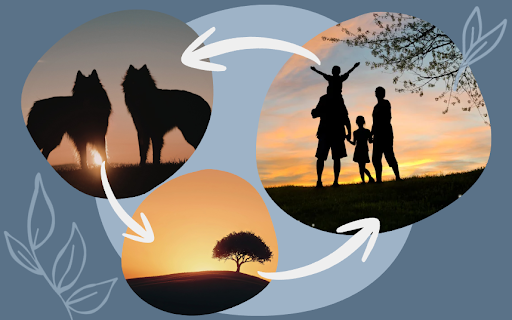
But there’s another way to see it: nature isn’t separate from us – it’s the ecosystem we live within. Our well-being is tied directly to the health of the world around us.
When we see nature this way, our relationship with it changes. We no longer relate to the Earth as something outside ourselves, but as something we are part of – something we depend on, and something that depends on us in return.
Nature is not a resource. It is kin.
When we relate to the natural world around us as kin, we stop asking, “What can I take?” and start asking, “How do I care? How do I give back? How do I reduce harm and protect what protects us?”
At Sarva Dharma, we believe progress grows from recognising this relationship and learning how to protect it.
A quick summary of this article:
- Seeing nature as kin shifts sustainability from “doing better” to “relating differently”, with care, respect, and reciprocity.
- An extraction mindset treats the Earth as a resource; a kinship mindset treats it as a living relationship. One to be nurtured.
- Reciprocity can be simple: reduce harm, restore what you can, and support the systems that protect life.
- Nature connection strengthens empathy for people, animals, ecosystems, and future generations.
- Community action makes kinship practical through shared projects like planting, clean-ups, education, and conservation.
- Sarva Dharma supports this shift through education, community, and government campaigns that make responsibility easier to practise.
Why This Mindset Matters Now
If nature is only a “resource,” then depletion feels inevitable, just a matter of efficiency and ownership. But if nature is kin, depletion becomes personal. Not in a painful, paralysing way – but in a clarifying way.
Because kinship changes the baseline:
- you don’t protect what you “use” the same way you protect what you love
- you don’t discard or exploit what you feel connected to
- you don’t harm what you recognise as kin
This is where mindful sustainability becomes powerful. It turns sustainability from a checklist into action – a way of living.
The Difference Between Extraction and Reciprocity
An extraction mindset asks:
- How much can I take for the lowest cost?
- How quickly can I replace what I’ve used?
- How can I make the damage invisible?
- How do I benefit without being affected by the consequences?
A reciprocity mindset asks:
- What does this place need?
- What am I taking, and at what cost?
- How do my choices affect life beyond me?
- What can I restore, protect, or support?
Reciprocity doesn’t require grand gestures. It requires consistency and a willingness to see the world as alive, not available.
What Reciprocity Looks Like in Daily Life
Kinship is not only spiritual or symbolic. It becomes real through habits – in the everyday decisions that shape how we live alongside the natural world. Reciprocity shows up when we slow down extraction, reduce waste, and consider the full impact of what we consume. It’s present in choosing food that respects land and season, repairing what can be repaired, sharing resources rather than discarding them, and using energy with awareness rather than excess.
These actions are not about doing everything or doing it perfectly; they are about staying in relationship with what sustains us, and recognising that care, repeated over time, is how kinship becomes practice.
Read Sustainable Living: Where to Start to learn how small, everyday choices can reduce harm.
Why Nature Connection Strengthens Compassion for People, Too
Kinship doesn’t stop at forests and rivers. When we expand our circle of care, it often extends to people too – especially those most affected by environmental harm.
Because environmental damage is never neutral. It hits communities differently. Some people have resources and buffers; others are exposed to risk first and worst.
A kinship worldview naturally supports environmental justice and climate justice because protecting life means safeguarding all life – human and non-human – with fairness and dignity.
Kinship, Lived in Community
It’s hard to live differently in isolation. Community is where change is supported, shared, and sustained.
Here are a few ways kinship can move from personal intention into collective practice:
- school or neighbourhood planting days
- nature-connection walks paired with education
- local clean-ups designed around care, not shame
- workshops that teach practical skills: reuse, waste reduction, restoration
- youth programmes that build empathy through experience outdoors
When communities practise care together, it becomes embedded in how people live and relate – shaping habits, values, and the choices that follow.
Frequently Asked Questions
It means seeing the living world as a relationship, not an object, something we belong to and care for, not something we exist above or outside of.
Both. Kinship can be a value-based worldview, but it becomes practical through daily choices: reducing harm, restoring ecosystems, and supporting community care.
Reciprocity means giving back to the systems that sustain you, through restoration, protection, mindful consumption, and supporting initiatives that reduce environmental harm.
Start with one repeatable habit (waste, food, water, energy, or consumption), then add one community action. Keep it small enough to maintain.
When people feel connected to nature, they’re more likely to protect it. Connection turns sustainability from obligation into care, which lasts longer.
Through experience, not fear: time outdoors, nature observation, storytelling, restoration projects, and language that builds responsibility without shame.
How Sarva Dharma Supports a Kinship-based Future
Sarva Dharma works to restore a sense of relationship between people, the planet, and all living beings – shifting away from extraction and toward shared responsibility. Through education, community engagement, and policy collaboration, we help make kinship a lived practice rather than a theory.
Our education campaigns support young people in understanding their connection to the natural world and the impact of their everyday choices. Community initiatives create spaces where care is practised collectively, through local action, skill-building, and shared reflection. At the systems level, we collaborate with institutions and governments to support frameworks that protect ecosystems and prioritise fairness, dignity, and long-term well-being.
By grounding action in relationship – not guilt or perfection – Sarva Dharma helps individuals and communities move from seeing nature as a resource to recognising it as kin, and to live in ways that protect what sustains us all.