If you have ever felt a quiet dread while reading the news, a creeping helplessness when the scale of the climate crisis comes into focus, or a guilt-tinged paralysis when you feel you are not doing enough – you are not alone, and you are not overreacting. A 2021 Lancet study surveying 10,000 young people across 10 countries found that nearly 60% described themselves as very or extremely worried about climate change, and more than 45% said those feelings adversely affected their daily functioning.
Caring about the planet is not a source of anxiety. But without a clear path from feeling to action, that care can tip into overwhelm. This blog is about finding that path.
A quick summary of this article:
- Climate anxiety is a recognised, legitimate emotional response to the scale of the climate crisis – not a sign of weakness or irrationality.
- Understanding the difference between productive concern and paralysing overwhelm is the first step toward channelling your feelings into something meaningful.
- Personal agency – the belief that your choices and actions genuinely matter – is one of the most effective psychological antidotes to climate-related despair.
- Burnout tends to arise when action is driven by guilt or obligation rather than values and purpose; reorienting motivation makes action more sustainable.
- Focusing on a specific, bounded area of action – rather than trying to respond to everything at once – protects both mental health and long-term commitment.
- Community and connection are powerful buffers against climate anxiety, reminding us that no individual carries this alone.
- Rest, nature, and self-compassion are not indulgences for climate advocates – they are the conditions that make sustained action possible.
What Climate Anxiety Actually Is
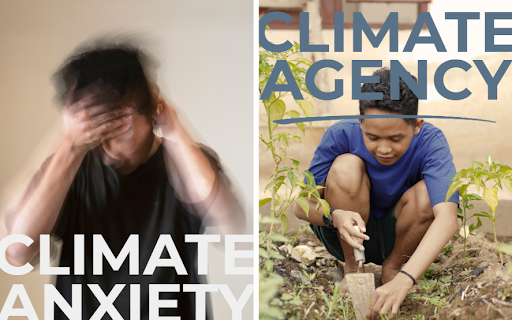
Climate anxiety – sometimes called eco-anxiety – is not a clinical disorder. It is a natural, rational response to a genuine and serious problem. Psychologists increasingly recognise it as a form of anticipatory grief: distress arising not from something that has already happened to you personally, but from a deep awareness of what is happening to the world, and what may come.
Among young people surveyed across 10 countries, two-thirds reported feeling sadness related to climate change, 62% felt anxious, and 67% said they were afraid. These are not the responses of people who care too much. They are the responses of people who are paying attention.
Acknowledging this matters, because the tendency to dismiss climate anxiety – to tell someone to “stop doomscrolling” or to “focus on the positives” – misses the point entirely. The feelings are real, and they are pointing at something real. The question is not how to stop caring. It is how to care in a way that does not consume you.
The Difference Between Concern and Paralysis
Not all climate-related distress functions the same way. Researchers broadly identify three ways people respond to climate anxiety:
- Problem-focused coping – taking action: reducing your carbon footprint, advocating, getting involved. Empowering when sustainable, but prone to burnout when driven by the sense that your individual effort must compensate for systemic failure.
- Emotion-focused coping – avoidance or denial: tuning out the news, convincing yourself it is someone else’s problem. Temporarily relieving, but tends to deepen disconnection and helplessness over time.
- Meaning-focused coping – acknowledging distress while cultivating purpose, resilience, and hope. The approach most consistently associated with long-term wellbeing and sustained engagement.
The third path is the one worth building. It does not ask you to pretend things are fine. It asks you to find, within an honest reckoning with the crisis, a sense of purpose that gives your response direction and staying power.
This is also central to Sarva Dharma’s approach: that lasting environmental action grows from internal conviction, not external pressure. From values, not obligation.
Why Guilt Is Not a Sustainable Fuel
One of the most common drivers of both climate anxiety and advocacy burnout is guilt – the persistent, low-level sense that you are not doing enough, not living purely enough, not sacrificing enough. It is an understandable response, but it is a poor foundation for long-term action.
Guilt is exhausting. It narrows focus onto perceived personal failure rather than opening it toward collective possibility. It tends to make people either overcommit until they collapse, or disengage entirely to escape the discomfort.
Purpose works differently. When action is rooted in genuine values – in care for living beings, in a sense of responsibility, in the belief that your choices are part of something larger than yourself – it becomes replenishing rather than depleting. You act because it aligns with who you are, not because you are afraid of who you will be judged to be if you do not.
The shift from guilt to purpose is not instant, and it is not always easy. But it changes the texture of engagement entirely.
Finding Your Sphere of Agency
One of the most disorienting aspects of the climate crisis is its scale. It encompasses energy systems, agricultural practices, geopolitical negotiations, corporate supply chains, and the daily decisions of billions of individuals. No single person can meaningfully engage with all of it. Trying to do so is a reliable route to overwhelm.
Personal agency in the climate crisis does not mean being responsible for all of it. It means identifying the areas where your specific actions, skills, relationships, and circumstances can have real effect – and focusing there.
For some people, this is their household: the food they eat, the products they choose, the energy they consume. For others, it is their professional sphere: the policies they influence, the organisations they work within, the younger people they mentor. For others still, it is community: the conversations they have, the local initiatives they support, the visible example they set for neighbours, friends, and family.
A useful question: where in my daily life do my choices intersect most directly with the natural world? That intersection is often where the most authentic and sustainable action lives.
On Doomism and the Case for Imperfect Action
Climate doomism – the belief that the situation is so far gone that action is pointless – is perhaps the most paralysing response of all, and it is worth addressing directly.
It is true that the scale of what is needed is enormous. It is also true that meaningful progress is happening: renewable energy is growing faster than most forecasts predicted, global deforestation rates are declining in key regions, and the cultural conversation around climate is more widespread and sophisticated than it has ever been.
None of this means the crisis is solved. But it does mean that the narrative of total inevitability is not supported by the evidence. And even setting the evidence aside: the argument that nothing matters is, by definition, impossible to act on. Whereas the belief that something can be done – even imperfectly, even incrementally – opens a door.
Researchers have found that young people themselves identify the need for a balance of hope and fear in climate messaging in order to spur genuine action. Neither pure alarm nor forced optimism serves people well. Honest, grounded hope – the kind that acknowledges difficulty while maintaining the possibility of meaningful change – does.
Imperfect action, taken consistently, is worth more than perfect action planned indefinitely.
Practical Ways to Move from Anxiety to Agency
Start Where You Are, Not Where You Think You Should Be
The gap between where most people are and where they imagine a “proper” environmentalist should be is one of the most common sources of paralysis. It is worth closing that gap by starting with whatever is genuinely accessible – not with whatever seems most impressive.
If reducing meat once a week feels manageable, that is a real starting point. Our Meatless Monday programme exists precisely for this reason: one day, one meal, one decision at a time. If composting feels doable, start there. If supporting an organisation whose values resonate with yours feels right, getting involved is a meaningful act.
The goal is not to cover every area at once. It is to find a genuine foothold and build from there, at a pace that is sustainable.
Limit the Information Loop Without Abandoning Awareness
Staying informed is important. Staying saturated is harmful. There is a meaningful difference between being aware of what is happening in the world and spending several hours a day consuming a continuous stream of climate-related distress through news and social media.
A few approaches that help:
- Set a boundary around when you engage with climate news – not to avoid reality, but to protect your capacity to engage with it thoughtfully rather than reactively.
- Seek out solutions-focused journalism and research alongside coverage of the crisis itself. The problem alone, without any signal of response, compounds helplessness.
- Notice how different sources and formats make you feel. Informed and motivated, or overwhelmed and inert? Both are signals worth following.
Protecting your attention is not the same as looking away. It is recognising that you can only act from a state of relative clarity, and that deliberately cultivating that state is part of the work.
Find or Build Community
Research consistently shows that one of the most effective ways to alleviate climate-related stress is through collective action – working alongside others toward a shared purpose. This is not simply a practical point about impact. It is a psychological one. Isolation amplifies anxiety. Connection, shared purpose, and the visible reality that others care too all serve as meaningful buffers.
This can take many forms. A local environmental group. A workplace initiative. A school or university programme. A conversation with a neighbour. Joining a broader network – like the Sarva Guardians community – where environmental responsibility is framed not as burden but as belonging.
The individuals who sustain long-term environmental empowerment are rarely those who act alone. They are those who find others who share their values and build momentum together.
Protect Your Capacity to Keep Going
Burnout is not a personal failing. It is what happens when the demands placed on a person – internally or externally – exceed the resources available to meet them. For climate advocates and environmentally conscious individuals, those demands can be enormous: the weight of the crisis itself, the sense of urgency, the frustration when change feels slow, the guilt when life’s demands get in the way of action.
Building personal climate resilience means treating your own wellbeing as a precondition for sustained contribution, not as a luxury you can attend to once everything else is handled.
In practice, this includes:
- Spending time in nature – not to solve anything, but to restore the relationship that motivated your concern in the first place. Direct experience of the natural world is consistently associated with reduced anxiety and renewed sense of purpose.
- Celebrating small wins – genuinely. The tendency to immediately move to the next problem without acknowledging progress is one of the fastest routes to exhaustion.
- Maintaining boundaries around your advocacy – understanding that you are one person within a much larger movement, and that sustainable contribution over years is worth more than total commitment for a few months followed by collapse.
- Giving yourself permission to rest – not because the crisis is paused, but because you cannot pour from an empty vessel.
The Role of Education in Building Lasting Agency
One reliable antidote to climate anxiety is knowledge – not the kind that amplifies fear, but the kind that builds genuine understanding of how systems work, where leverage points exist, and what actions at which levels produce real change.
This is part of why environmental education and community work matters so much. When people understand the connections between their choices and the world around them – not in a guilt-inducing way, but in an empowering one – they are better equipped to act with confidence and to sustain that action over time.
Climate literacy transforms the experience of the crisis from something happening to you into something you have some capacity to respond to. That shift – from passive recipient to active participant – is one of the most significant psychological changes available to anyone navigating climate anxiety.
You Are Not Responsible for Solving This Alone
Perhaps the most important thing to hold onto, in all of this: the climate crisis is not your failure, and it is not yours alone to fix.
You did not design the energy systems, agricultural models, or economic structures that produced it. You did not choose, individually, the conditions of the world you were born into. What you can choose is how you respond to those conditions – with awareness, with compassion, with action proportionate to your circumstances and sustained over time.
That is not a small thing. It is, in fact, exactly the kind of change that builds – person by person, community by community – into something that matters at scale.
Caring is not the problem. Caring, channelled with intention and supported by community, is precisely the answer.
Frequently Asked Questions
Climate anxiety – sometimes called eco-anxiety – is emotional distress arising from awareness of the climate crisis and concern about its future impacts. It commonly manifests as worry, sadness, helplessness, or a sense of grief. It is a recognised and understandable response, not a disorder.
Yes. Studies show that among young adults across multiple countries, around 75% report feeling frightened about the future, and approximately 45% say their worries about climate change negatively affect their day-to-day functioning. These feelings are widely shared and entirely valid.
By shifting from emotion-focused coping (avoidance or denial) toward meaning-focused coping: acknowledging distress honestly while building a sense of purpose and identifying specific, manageable actions you can take. Agency – the belief that your choices genuinely matter – is one of the most effective psychological antidotes to paralysis.
Burnout typically arises when action is driven by guilt or the sense that individual effort must compensate for systemic failure. Over-commitment without rest, isolation, and focusing on scale rather than achievable impact are also common contributors. Reorienting motivation from obligation to values makes sustained action far more manageable.
By identifying where your specific circumstances, skills, and daily choices intersect most directly with the natural world – and focusing there. Personal climate agency does not require engaging with every aspect of the crisis. It requires finding a genuine point of connection and building from it.
Being informed is valuable. Staying saturated is not. Setting intentional limits on when and how you engage with climate news – and seeking out solutions-focused content alongside crisis coverage – protects your capacity to respond thoughtfully rather than reactively.
Research consistently supports this. Working alongside others toward a shared purpose reduces isolation, provides perspective, and creates the experience of collective efficacy – the sense that the group can achieve what the individual cannot. Community is not a supplement to environmental action; it is integral to it.
Realism acknowledges the genuine severity of the climate crisis without concluding that action is therefore pointless. Doomism – the belief that the situation is irreversible and nothing matters – tends to function as a rationalisation for disengagement rather than an honest assessment. Progress is happening alongside the crisis. Both truths coexist.
Through education, community, and encouragement – without pressure or judgement. We believe that lasting environmental action grows from personal conviction, and we support individuals in finding their own grounded, values-driven path to contribution. Our environmental education and community work is built on this foundation.
Name the feeling. Recognising that what you are experiencing is a legitimate emotional response – not a sign of weakness or irrationality – is the beginning of being able to work with it rather than being overwhelmed by it. From there, identifying one small, specific, meaningful action is often enough to shift the experience from helplessness to agency.
Your Concern Is a Compass, Not a Cage
The fact that you feel something when you think about the state of the planet is not a burden. It is information. It tells you that you are paying attention, that you care, and that you understand – at some level – that your life is connected to the lives of others, human and non-human alike.
That understanding, channelled well, is one of the most powerful forces available. Not because any individual changes everything. But because the cumulative weight of people who have moved from anxiety to agency – who have chosen to act within their sphere, consistently and with compassion – is what shifts culture, and what shapes the world their children will inherit.
Explore our work and find out how Sarva Dharma supports individuals in finding their own purposeful path to environmental action.
Sources
Hickman, C., Marks, E., Pihkala, P., Clayton, S., Lewandowski, R. E., Mayall, E. E., Wray, B., Mellor, C., & van Susteren, L. (2021). Climate anxiety in children and young people and their beliefs about government responses to climate change: A global survey. The Lancet Planetary Health, 5(12), e863–e873. https://doi.org/10.1016/S2542-5196(21)00278-3
Kaya, M. S., Hawkins, E., & McCabe, C. (2026, January). Views on climate change, climate action and mental health, in young people with and without existing depression symptoms: A qualitative study. Journal of Climate Change and Health, 27, 100606. https://doi.org/10.1016/j.joclim.2025.100606
Ogunbode, C. A., Doran, R., & Böhm, G. (2025, September 15). Climate anxiety in perspective: A look at dominant stressors in youth mental health and sleep. Annals of the New York Academy of Sciences, 1552(1), 249–262. https://doi.org/10.1111/nyas.70057
Protect Our Winters Canada. (2021, November 16). Eco-anxiety and advocacy burnout. https://www.protectourwinters.ca/eco_anxiety_and_advocacy_burnout
Saplakoglu, Y. (2026, March 11). Climate anxiety is taking its toll on young people. Time. https://time.com/7280989/climate-anxiety-mental-health-young-people/