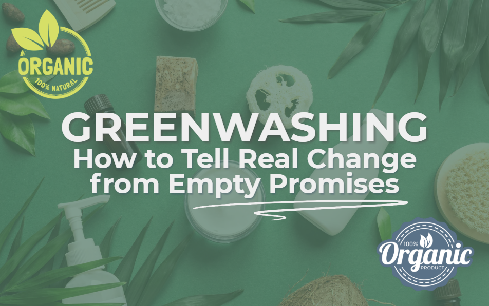
Walk down almost any supermarket aisle and you’ll see it: leafy green packaging, words like “natural” and “conscious” in soft typefaces, labels that feel reassuring without saying very much at all. Some of it reflects genuine effort. A lot of it doesn’t.
This gap between appearance and substance has a name: greenwashing. Learning to spot it isn’t about becoming cynical toward every environmental claim. It’s about knowing which ones are worth your trust, and your money.
A quick summary of this article:
- Greenwashing makes a brand or product look more environmentally responsible than it actually is.
- Vague, unverifiable language is one of the clearest signs a claim isn’t backed by real action.
- Genuine sustainability tends to be specific, measurable, and consistent over time.
- Certifications and eco-labels vary widely in credibility and aren’t a guarantee on their own.
- Learning to spot greenwashing helps you support real progress instead of clever marketing.
What Greenwashing Actually Is
Greenwashing is the practice of making a product, company, or policy appear more environmentally responsible than it genuinely is, usually through vague language, selective disclosure, or imagery that implies more than the facts support.
It isn’t always outright dishonesty. Often it’s a company genuinely doing something small and modest, then marketing it as though it were transformative. The gap between the claim and the reality is where greenwashing lives.
The Language That Should Make You Pause
Certain phrases tend to show up whenever a claim can’t survive much scrutiny. Words like “eco-friendly,” “natural,” or “conscious,” used without any specifics attached, are often doing more marketing work than environmental work.
A useful habit is to ask what exactly is being claimed. “Made with recycled materials” could mean 5% or 95%. “Carbon neutral” could mean genuine reduction, or it could mean offsets purchased to balance out unchanged behaviour. Vagueness is rarely accidental.
What Real Change Actually Looks Like
Genuine sustainability claims tend to share a few traits that greenwashing usually lacks:
- Specific numbers rather than vague adjectives, such as a stated percentage reduction, not just “more sustainable.”
- Consistency over time, rather than a single campaign or product line while the rest of the business continues unchanged.
- Transparency about what still needs improvement, not just what’s already been achieved.
- Third-party verification, rather than only the company’s own claims about itself.
Are Certifications and Labels Trustworthy?
Certifications can genuinely help, but they aren’t a guarantee on their own. Standards vary enormously between labelling schemes, some involve rigorous independent audits, others are closer to a badge a company can largely award itself.
A quick habit worth building: look up what a certification actually requires before treating it as proof. A label backed by regular, independent verification carries far more weight than one that simply exists.
Supporting Real Progress, Not Just Good Marketing
Once you can spot the difference, it becomes much easier to direct your time, money, and attention toward things that actually matter, rather than whatever’s marketed the loudest.
That might mean paying closer attention to the everyday choices behind your food, where genuine change is often quieter and less branded than a shelf label. It might mean choosing organising a visible, verifiable action like a community clean-up over supporting a campaign you can’t actually verify.
Often, the most trustworthy sustainability doesn’t announce itself loudly at all. It looks like living a little more gently on the earth, without needing to announce it – consistent, unglamorous, and rarely built around a marketing campaign.
Frequently Asked Questions
Greenwashing is when a product, brand, or organisation is marketed as more environmentally responsible than it actually is. It’s widespread enough that it’s worth approaching most environmental claims with a habit of checking specifics rather than accepting them at face value.
Vague language without specific figures, imagery that implies more than the claim states, and sustainability efforts confined to a single product line while the rest of the business continues unchanged are all common warning signs.
Look for specific, measurable figures, independent third-party verification, and consistency across the whole business rather than a single marketed initiative. If a claim can’t be traced to a source, it’s worth treating cautiously.
It depends entirely on the certification. Some involve rigorous independent audits; others are closer to self-awarded badges. It’s worth briefly researching what a specific label actually requires before treating it as proof.
Favour specificity over slogans, consistency over one-off campaigns, and transparency over polished imagery. Real progress tends to be quieter and less perfectly marketed than greenwashed alternatives.
Look Past the Label
None of this means assuming every environmental claim is false. It means giving genuine progress the trust it deserves, and giving marketing dressed up as progress a little more scrutiny.
Accountability tends to follow public demand. If you’d like to help raise it, see how you can make a difference today.