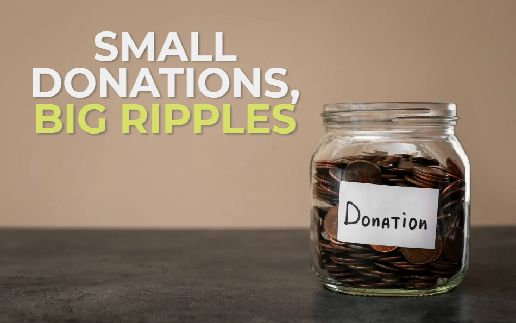
It’s easy to assume a small donation barely registers against a problem as large as the climate crisis. A few pounds or dollars, set against melting ice caps and global supply chains, can feel almost symbolic rather than meaningful.
But that framing misses how change actually gets funded. Most NGOs don’t run on a handful of enormous gifts. They run on many small, consistent ones, arriving often enough to fund real, ongoing work.
A quick summary of this article:
- Small donations rarely fund grand gestures – they fund the ongoing, unglamorous work that adds up over time.
- Most NGOs rely on many modest, consistent gifts far more than occasional large ones.
- Transparency and specificity are the clearest signs a donation is being used well.
- Monthly giving tends to fund more reliable, planned work than one-time donations alone.
- Money isn’t the only way to contribute – time and participation matter too.
What a Small Donation Actually Funds
A single contribution rarely buys a dramatic, visible outcome on its own. What it actually funds is usually smaller and less photogenic: a portion of a workshop, a fraction of a campaign, part of a staff member’s time spent coordinating a community project.
None of that sounds especially inspiring in isolation. But that’s exactly how most meaningful environmental work actually gets funded, in fragments, contributed by many people, rather than delivered whole by any single gift.
Why Many Small Gifts Outperform a Few Large Ones
Relying on a small number of large donors is fragile. If one steps back, a significant part of an organisation’s funding disappears with them. A broad base of smaller, consistent contributions is far more resilient, and it also means an organisation answers to many people’s trust rather than a handful of major funders.
This is part of why every contribution genuinely does create ripples of change: it’s rarely about the size of any single gift, and much more about the reliability of many gifts arriving together.
One-Time Giving vs. Monthly Support
A one-time donation is valuable, especially around a specific campaign or urgent need. But monthly giving tends to fund something one-time gifts often can’t: predictable, planned work that doesn’t depend on unpredictable spikes in attention or news coverage.
If you’re deciding between the two, it’s worth looking at the different ways to fund this work directly, since most organisations, including ours, offer several structures depending on what fits your situation.
How to Know Your Donation Is Being Used Well
The same instincts worth applying to spotting greenwashing apply here. Look for specifics rather than vague appeals: what exactly is the money funding, how is progress measured, and is the organisation transparent about what’s working and what isn’t.
An organisation confident in its work usually has no trouble being specific about where contributions go. Vagueness, on the other hand, is often a sign worth pausing on.
Money Isn’t the Only Way to Contribute
Financial support matters, but it’s not the only meaningful way to participate. Time and direct involvement carry their own kind of impact, one that’s sometimes even more visible day to day.
If funding isn’t the right fit for you right now, a hands-on option like organising a community clean-up offers a different, equally valuable way in. Either path connects to the same underlying idea: how communities become stronger through shared responsibility, whether that responsibility is carried through money, time, or both.
Frequently Asked Questions
It genuinely makes a difference. Most environmental work is funded by many modest, consistent donations rather than a handful of large ones, so small gifts collectively fund a significant share of ongoing programmes.
Look for specificity and transparency: organisations that clearly explain what funding supports and how progress is measured are generally more trustworthy than those relying on vague appeals.
One-time gifts are valuable for specific campaigns, while monthly giving funds more predictable, ongoing work. Neither is inherently “better” – they simply support different kinds of need.
Yes. Volunteering time, participating in local initiatives like clean-ups, and raising awareness are all meaningful contributions that don’t require financial giving.
This varies significantly by organisation. Transparent charities are typically willing to share this breakdown directly, so it’s worth asking or checking published financial reporting before giving.
Every Ripple Counts
No single small donation will solve the climate crisis alone. But collectively, that’s exactly how meaningful environmental work gets funded, one modest, consistent contribution at a time.
If you’d like to be part of that, there’s room for you here. You can fund our ongoing work with a one-time or monthly contribution, or give your time as a volunteer. Whichever you choose, you’ll be helping to turn care for the planet into steady, practical action, entirely at your own pace.